COP30 in Belém (2025) focused on implementing existing climate pledges, delivering some progress on adaptation and finance but falling short on fossil fuel commitments, with outcomes reflecting the challenges of global consensus and the urgent need for faster action.

COP30 in Belém: Outcomes, Signals, and the Road Ahead
5 December 2025
Article last updated 8 December 2025.

Nicola Day, Deputy Head of Greenbank
COP30 in Belém convened against a backdrop of accelerating climate stress. Global temperatures have repeatedly exceeded historic highs, ice loss is intensifying, extreme weather is becoming more frequent, and ecosystems are showing visible signs of strain.
On Saturday 22nd November, more than a day behind schedule COP30 concluded after fraught procedural disputes. The resulting decision secured some important wins, within and outside of the United Nations Framework on Climate Change (UNFCCC) framework, however it fell short of tackling several big-ticket items many had expected to see addressed.
The focus was on delivering a COP centred on implementation of existing pledges and processes rather than announcing new ones.
Developing nations were well represented at COP30, and they continued to stress the inequity of the current climate burden, with escalating impacts and limited financial support from developed nations. This exposed the north–south divide at the heart of every COP, where those least responsible face the sharpest costs.
The US, China and India’s leaders chose not to attend the pre-COP heads-of-state meeting, highlighting the difficult geopolitical backdrop and renewed questions over climate leadership. China and India did, however, send full delegations to the main negotiations. The US, still in the UNFCCC, although due to leave the Paris Agreement next year, did not send a federal delegation, making the presence of around 100 American mayors and other sub-national figures an important sign of continued US engagement.
The Belém Package
The Conference’s principal outcome was the Belém Package, which included the negotiated decisions and the “global mutirão”, which framed collective ambition beyond the formal text, on issues including adaptation finance, ambition, transparency, and trade. Mutirão, a term taken from the Tupi-Guarani language and meaning ‘collective effort’ was chosen intentionally to highlight both the need for continued collaboration and the importance of indigenous voices in climate negotiations.
With around 56,000(1)participants and strong Indigenous and civil-society visibility, the summit opened constructively. However, it ended turbulently, with multiple delegations protesting the premature gavelling of decisions and deep disappointment over the lack of mention of fossil fuels in the final text.
The COP’s consensus-driven process meant that the final text was weaker than many had hoped, delivering incremental rather than transformational progress.
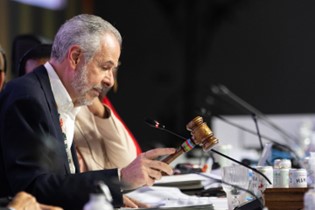
André Corrêa do Lago, COP30 president, brings the gavel down to formally adopt the concluding decisions at COP 30 on November 22, 2025, UNFCCC
National Commitments and Global Ambition
A major task for COP30 was securing updated Nationally Determined Contributions (NDCs) for the period through to 2035. These are countries’ climate action plans for cutting emissions and adapting to climate impacts. The Paris Agreement requires revisions every five years, and 2025 represented a key checkpoint for assessing ambition. Over the course of the summit, the number of submitted NDCs rose from 65 to 122(2), giving a clearer sense of global emissions pathways.
While the updated plans bend the emissions curve downward, they still place the world on a trajectory for well above 1.5°C in warming, with the likelihood of overshooting that target now explicitly acknowledged. Even so, it is evident that political pressure from the COP process boosted numbers of submissions, despite limited ambitions in some of the NDCs.
The COP 30 presidency launched two new implementation processes to raise ambition for national plans:
- Global Implementation Accelerator — a voluntary platform focusing on execution – helping countries follow through on existing commitments within NDCs and national adaptation plans
- Belém Mission to 1.5°C — a joint COP30–COP31 presidency effort to identify enabling actions that can strengthen near-term ambition
The Global Goal on Adaptation
Adaptation was a central component of the Belém Package. Climate change impacts are no longer a future threat; they are already unfolding, and countries must now adapt to the changes occurring alongside efforts to mitigate emissions.
Developing nations, which are being hit hardest, strongly pressed for faster progress on adaptation. Parties adopted 59 indicators for the Global Goal on Adaptation, with a two-year refinement workstream. Concerns, however, persisted about the opaque drafting process and the weakening of some indicators.
The mutirão decision also “called for efforts” to triple adaptation finance, but without an agreed baseline year and with a 2035 target, leaving the level of ambition difficult to measure.
Energy Transition and forestry
COP30 failed to secure explicit UNFCCC language on “transitioning away” from fossil fuels, which had been a breakthrough at COP28 and had disappeared at COP29. More than 80 countries had pressed hard for its reinstatement in Belém so this was a bitter disappointment.
With references to transitioning away from fossil fuels and to reforestation absent from the final COP30 outcome text, the COP30 President used the closing plenary to signal that these priorities would continue through presidency-led initiatives outside the formal negotiations.
Two political tracks were announced to maintain momentum.
The first is the Colombia–Netherlands just transition away from fossil fuels roadmap, endorsed by 22 countries. The Presidency advanced this roadmap to take forward work that remained unresolved amid divisions highlighted during the Mutirão consultations.
The second is the Presidency forestry political track to carry forward work on forest and land-use priorities. Separately, Brazil’s Tropical Forests Forever Facility (TFFF) was launched at COP 30 as a flagship forest-finance initiative, with the Amazonian setting underlining its significance. $6.6bn(3)was committed over COP30, below the target of $25bn and far short of the $125bn broader goal for private sector mobilisation.
Colombia will also host the first international conference on the “Just transition away from fossil fuels” in April 2026.
Together, these presidency-led initiatives create structured avenues for continued progress beyond the UNFCCC negotiating process.
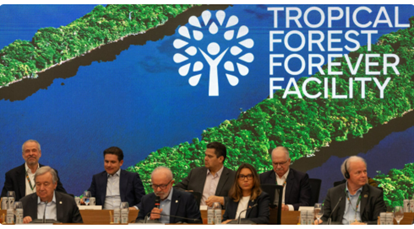
At COP30 in Belém, delegates unveil the Tropical Forest Forever Facility, signalling a major new commitment to sustained finance for tropical forest conservation, UNFCCC
Just Transition Mechanism
COP30 agreed a landmark decision to create the first Just Transition Mechanism under the UNFCCC. This is intended to support countries with cooperation, technical assistance, capacity-building and knowledge sharing as they shift towards low-carbon economies.
Negotiations however exposed deep divisions over fossil-fuel language and the role of transition fuels, whilst early proposals to address social protections and risks linked to critical minerals were also removed in the final text.
While establishing the mechanism is a major step, its impact will depend on securing a budget and operational plan in the coming year.
Carbon Markets
At COP30, countries made steady progress on the technical rules that govern carbon markets under Article 6. Two key focus areas were tightening oversight for bilateral carbon credit trading and advancing the governance and registry systems needed to launch the UN-run central registry mechanism. Although this central registry is not yet operational, the work completed in Belém means it is moving closer to issuing its first credits in the coming years.
Alongside these negotiations, several countries highlighted bilateral trading is already functioning in practice. For example, Switzerland expanded its bilateral agreements with partners such as Zambia, Mongolia and Uganda. These developments show that while COP30 was largely about refining the rulebook, international carbon markets are beginning to move from design to early implementation.
Carbon markets matter because they help establish a credible price on carbon and bring coherence to fragmented international carbon trading. Article 6 reforms agreed begin to put proper guardrails in place, giving countries greater confidence that traded credits will meet consistent integrity standards.
Climate Finance
The summit reaffirmed the Baku-to-Belém Roadmap, including work programmes running through 2027 to identify how public and private finance could be scaled up.
Under the ‘New Collective Quantified Goal’, agreed at COP29, developed countries committed to mobilising US $300 billion per year by 2030, rising towards US $1.3 trillion annually by 2035.
The roadmap is intended to guide how developed countries scale finance for developing nations. It sets out the process to explore pathways to these levels, but COP30 delivered few concrete finance pledges, meaning progress remains largely conceptual rather than material.
Action Agenda
The COP30 Action Agenda brought together hundreds of voluntary initiatives from cities, regions, businesses and civil society into a streamlined set of plans to accelerate climate delivery outside the formal negotiations.
A central pillar of this multilevel push is the Coalition for High Ambition Multilevel Partnerships for Climate Action (CHAMP). By COP30, 78 countries plus major regional blocs had endorsed CHAMP, committing to involve sub-national governments (cities, states, regions) in designing and delivering national climate plans.
Alongside that, other sectoral coalitions and alliances renewed or expanded their climate-finance pledges. For example, the Utilities for Net Zero Alliance (UNEZA) raised its clean-energy investment goal to US$150 billion per year, focusing on modernising and expanding electricity grids and other enabling infrastructure such as storage, interconnectors and digital grid upgrades.
Beat the Heat,” an initiative that supports cities in tackling rising extreme-heat risks, also expanded at COP30 as more cities committed to scaling practical cooling and resilience measures.
Signals and the road ahead
COP30 demonstrated both the limitations and the necessity of the UN climate process. COPs are there to create frameworks, signals, rules, and "pressure”, but they are only one part of how progress happens across a wider climate action ecosystem.
While consensus meant the final text fell short of the higher ambition many countries had sought, particularly on fossil-fuel language, the conference showed the value of bringing all countries around the table for global talks, to work through differences, clarify red lines, and build the multilateral alignment needed for deeper action.
Across the negotiations and the presidency-led tracks, COP30 marked a shift from creating new pledges to implementing on existing ones, with practical progress emerging through strengthened Article 6 carbon trading rules, new implementation platforms, and coalitions of more than 80 countries calling to accelerate the transition away from fossil fuels.
These elements show that ambition signals continue to strengthen even when they cannot all be translated into the formal text. It also indicated that future progress could increasingly be driven by initiatives operating beyond the UNFCCC negotiations, including the presidency’s roadmap and the Colombian international conference planned for April 2026.
For financial markets, COPs tend to have little immediate impact, but they are important in signalling the direction of travel for policy, transition risk and the pace of sectoral transformation to inform capital allocation.
The solutions are on the ground now and scaling quickly: clean technologies are accelerating, renewable deployment continues to rise, and adaptation efforts are increasingly embedded in planning and investment. The discussions in Belém made it clear that an overshoot of 1.5°C is increasingly likely, meaning adaptation will need to expand rapidly alongside mitigation.
These shifts highlight both the risks for incumbents that fail to keep pace, including transition and stranded-asset risks and the opportunities for companies expanding climate solutions, from clean energy and electrification to grid infrastructure and nature-based solutions.
COP30 delivered nudges rather than breakthroughs - progress, but still far short of the pace the climate challenge demands.
_______________________________________________________________
(1) 1https://enb.iisd.org/sites/default/files/2025-11/enb12888e.pdf
(2) Source: UNFCCC (2025). Closing press conference remarks by the Executive Secretary, COP30. The Executive Secretary reported that NDC submissions increased from 65 prior to COP30 to 122 by the close of the conference
(3) Carbon Brief. “COP30: Key outcomes agreed at the UN climate talks in Belém.” Carbon Brief, 2025