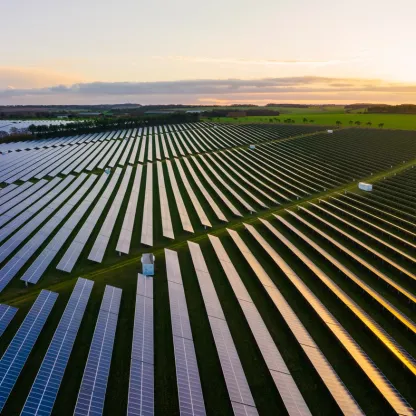
Looking ahead to 2026, systemic risks linked to climate change, inequality and biodiversity loss continue to shape the global economic landscape. These unresolved pressures guide Greenbank’s engagement priorities for the year ahead, centred on climate, nature and human rights.

2025 in review – Market commentary
19 January 2026
Article last updated 19 January 2026.
As we enter 2026, it provides an opportunity to reflect on the previous year, take stock of the current situation, and share some thoughts on how we are positioning portfolios for the year ahead.
Global equity markets delivered a third consecutive year of double-digit returns in 2025, underscoring the resilience of the global economy. Indices in Hong Kong, Japan, Germany, and the UK all outpaced the S&P 500 index of US stocks, marking 2025 as the first time in two decades that the S&P 500 ranked as the weakest among major equity markets. Indicators point to modest but improving growth in the US, and towards year end, optimism around fiscal and monetary stimulus-fuelled rallies across major asset classes, making it the first time since the pandemic that they all posted positive returns.
Periods of volatility were a notable feature of the year, much of it stemming from policy developments in the United States. One of the most significant episodes occurred when President Donald Trump unexpectedly announced “liberation day” tariffs, prompting a sharp, nearly 20% decline in US equities and exerting downward pressure on both bond markets and the dollar. Markets recovered once the tariffs were paused, but the episode highlighted how sensitive sentiment remains to policy uncertainty.
A further disruption occurred in October when President Trump again raised the prospect of punitive trade restrictions on China. This tension eased only when President Xi Jinping signalled that China might respond by tightening export controls on rare earth minerals—materials crucial to global supply chains and an area where China commands overwhelming refining capacity. Given the administration’s reliance on trade threats as a policy instrument, similar episodes may arise in 2026, although significant economic or market disruption may prove politically undesirable in an election-related environment.
The Trump administration has also continued to take an ‘anti-ESG’ stance in many of its policy decisions, rolling back or cancelling numerous social and environmental commitments and standards. In a year that saw ocean acidification become the seventh of nine critical earth systems boundaries to be breached, and with our world edging ever closer to critical tipping points in the climate system, and ten years since the landmark Paris Agreement on climate change, addressing systemic environmental risks is more important than ever. Despite policy changes under the Trump administration that shifted support from low carbon technologies to fossil fuels, data released at the end of the year showed that the longer-term decline in greenhouse gas emissions in the US means the country remains on a pathway where emissions remained stable or fell while the economy grew. This reinforces our view that in many areas, it is now economics rather than policy that is driving decarbonisation.
Artificial intelligence remained the defining theme of 2025, with communication services and technology sectors outperforming. Investor uncertainty persists over long-term winners and losers in the AI race, but predictions are being formulated with limited visibility. These concerns resulted in only a few of the “Magnificent 7” outperforming the S&P 500 overall, while the perceived AI “losers” faced persistent negative pressures from market sentiment. Despite much deliberation as to whether we are in an AI bubble, signs of speculative excess remain limited. Unlike previous bubbles, today’s AI cycle is largely funded by cash flows from highly profitable, cash rich firms, reinforcing their ability to self-finance the investment. Whilst many tech companies have soared over recent years, we continue to broaden our exposure beyond the primary innovators, into enablers and adopters, and geographically, with technology’s influence spreading globally, now accounting for 27% of emerging market indices. We expect this trend to broaden further.
We continue to believe that generative AI will deliver significant long‑term benefits for companies and consumers, though broader societal and environmental consequences may be more mixed. Our continued engagement with the World Benchmarking Alliance’s collaborative project on ethical AI is one of several ways in which we are seeking to encourage responsible practices to be embedded within AI models and their implementation.
Within Europe, Germany announced a substantial fiscal expansion in 2025, primarily targeting infrastructure and defence sectors, alongside broader European countries pledging to spend 5%, previously 2%, of GDP on these sectors to improve their independency. The size of the expansion is significant and should make a clear difference to the Eurozone economy. Our stance on European equities is unchanged as we anticipate that increased spending will translate into stronger earnings momentum in 2026.
Inflation does, however, continue to pose challenges. Core inflation in both the United States and the United Kingdom has been slow to return to 2% targets. We expect inflation to remain somewhat higher and more volatile than in the pre‑pandemic era, influenced by structural factors including persistent fiscal deficits, climate‑related costs, demographic pressures and reduced global integration.
Interest rate policy reflects these dynamics. The Bank of England has paused cuts, balancing sticky inflation against economic slack, though one or two reductions remain likely. The Federal Reserve continues gradual easing amid debate over upside inflation risks, while the ECB is expected to maintain low rates given inflation’s stability.
Political developments will also shape market conditions in 2026. In the UK, the May local elections are expected to be a significant test for Prime Minister Keir Starmer, and betting markets reflect limited confidence in his longer‑term prospects. A leadership change that shifts Labour further to the left could increase policy uncertainty. In the United States, the political cycle is moving toward the November midterm elections, and the administration will likely be keen to avoid economic disruptions that could affect voter sentiment.
The themes of 2025 reinforce the importance of diversification. Whilst the U.S. still dominates global equity benchmarks at 65%, its weakened dollar and record of 40% concentration in just 10 companies, has prompted investors to explore other regions and alternative asset classes. We anticipate a broader dispersion of returns in 2026 as companies harness productivity gains from generative AI, as momentum shifts across sectors with renewed strength in areas such as healthcare, and safe-haven assets like precious metals are favoured over traditional choices such as government bonds and the US dollar. These dynamics reinforce our view that diversification remains essential for achieving sustainable long-term returns.