Many companies remain unprepared for the EU Deforestation Regulation, according to a recent report, despite repeated delays giving businesses additional time to adapt. The findings highlight persistent challenges around compliance, resourcing and supply chain transparency ahead of the regulation’s phased implementation.

Sustainability update May 2026
4 June 2026
Article last updated 5 June 2026.
Many companies still unprepared for upcoming implementation of EU Deforestation Regulation, report finds
Originally adopted by a majority of the European Parliament in 2023, the EU Deforestation Regulation (EUDR) has faced a series of implementation delays and postponements. The regulation’s core aim is to ensure that products sold in the EU don’t originate from recently deforested land, but compliance issues across member states, political pushback, and business concerns about mobilising the necessary resources have resulted in the European Commission extending rollout to the end of 2026 for large and medium-sized businesses, and 30 June 2027 for micro and small enterprises. The EUDR has also had to navigate a broader geopolitical shift away from climate- and nature-related priorities.
Global Canopy’s annual Forest 500 Report examines the commitments on deforestation, land conversion and human rights of 500 companies with significant influence on the global trade of nine forest-risk commodities: beef, cocoa, coffee, leather, palm, pulp and paper, rubber, soy, and timber. The 2026 report argued that while the EUDR was effective in changing corporate practices, progress was still too slow and uneven to adequately meet global deforestation goals. Overall, it found that 313 in-scope companies had taken steps to address deforestation, albeit with limited commitments or implementation measures. Among the positives, companies were increasingly citing the EUDR as a reason for enhancing supply chain monitoring and traceability – 68 companies referenced the EUDR in relation to their deforestation efforts, while 45 businesses directly linked the regulation to new traceability initiatives. Additionally, evidence of traceability systems increased for eight of the EUDR’s nine forest-risk commodities.
The report nevertheless found that only 146 in-scope companies had deforestation commitments covering all the forest-risk commodities they produced or sourced, while just over a third had failed to register any public deforestation commitments. Since the 2024 report, 14 companies had weakened or withdrawn their commitments, reduced certification participation, or softened their policy stance.
Among Forest 500’s recommendations, companies were urged to conduct robust deforestation risk assessments and extend comprehensive zero-deforestation commitments across all forest-risk commodities, while governments were encouraged to fully implement and enforce deforestation regulations and resist lobbying efforts to undermine them. Investors and financial institutions were advised to strengthen deforestation due diligence, improve portfolio risk assessments, and exercise strong stewardship to drive progress in corporate action on forests. Crucially, the report concluded that even in its imperfect form, the EUDR was working to solve the crisis of commodity-driven deforestation.
We are supportive of policy that encourages better oversight and management of social and environmental risks, including EUDR. We have recently fed into an investor consultation coordinated by the Institutional Investors Group on Climate Change (IIGCC) in response to proposed changes to EUDR. The consultation was a critical juncture for the EUDR's ambition and our IIGCC's response aimed to represent the collective voice of institutional investors in defending and strengthening the regulation's scope.
Deforestation and land-use change account for approximately 11% of global greenhouse gas emissions, presenting a systemic risk that cuts across asset classes and sectors. For diversified investors, the EUDR offers a regulatory framework through which portfolio companies can be held to account on supply chain due diligence, traceability and deforestation-free sourcing, all of which are material to long-term value creation, transition planning and nature-related risk management.
Climate Action 100+ releases updated corporate net zero benchmark and announces strategic partnership to strengthen climate governance
Climate Action 100+, the leading investor engagement initiative on climate change, released an updated version of its Net Zero Company Benchmark framework used to assess target companies on the development and progress of their net zero transition plans. First launched in 2021, the framework evaluates companies against three core goals to direct investor engagement: emissions reduction, governance, and disclosure.
Drawing on stakeholder feedback, the updated framework aims to improve investor clarity and usability without diluting its 2050 net zero ambition or the level of focus on corporate progress. Changes and refinements reflect a broader streamlining of the framework to prioritise the most decision-useful and engagement-relevant metrics. They also recognised that climate disclosure expectations were increasingly embedded within evolving regulatory systems and market practices. The updated benchmark will consolidate all climate policy engagement metrics through InfluenceMap to cut down on duplication and improve data consistency. InfluenceMap is a world leader in corporate climate policy analysis, providing data-driven assessments to promote accountability in climate action – their LobbyMap database tracks the efforts of the world's largest companies and industry associations to influence climate policy in real-time. Benchmark assessments under the revised framework are scheduled for publication in October 2026.
The initiative also announced a new strategic partnership with the World Benchmarking Alliance (WBA) aimed at strengthening how investors assess and engage major companies on climate transition performance. Alongside broader plans to improve investor engagement and climate governance assessment, a major target of the partnership is to track companies’ absolute emissions reductions more effectively and focus investor attention on measurable decarbonisation efforts rather than disclosure alone.
AI datacentres increasing the strain on domestic energy supplies
Research by the International Data Center Authority (IDCA) indicated that growing power usage and demand for grid connectivity across AI datacentres in major economies could trigger “significant community and political backlash”. Global annual AI infrastructure investments are approaching $1 trillion and the energy used to power facilities had increased by 15% in just two years. The global average for datacentre energy consumption was estimated to be 2%, but the UK and US both recorded consumption rates of 6%. The IDCA warned that societal pushback was likely to occur in countries where datacentres consumed more than 5% of domestic grid capacity. In some countries, consumption rates were approaching unsustainable levels: according to the IDCA, Singapore’s datacentre network consumes nearly a fifth of the country’s grid capacity.
The UK’s consumption rate was significantly higher than the government’s 2.5% estimate published in 2025, and a 460% increase in connectivity applications during the first half of the year has prompted reforms to tackle speculative applications delaying strategically important projects by up to 15 years. The government also conceded it had seriously underestimated the climate impact of the UK’s AI development programme – data from the Department for Science, Innovation and Technology estimated that domestic datacentres could result in up to 123m tonnes of additional carbon emissions, roughly equivalent to the carbon footprint of 2.7m people.
Companies worldwide are increasingly turning to AI to support core business functions and enhance data analytics – IDCA estimates placed the current value of the global digital economy at around $16 trillion, or 15% of the world’s nominal GDP. Concerned about the potential long-term social and environmental impacts of unchecked AI development, the IDCA and environmental campaigners called for greater corporate transparency on pipeline projects, more reliable data on AI infrastructure energy and water consumption, and steps to ensure that fossil fuel producers aren’t thrown a lifeline due to increasing energy demand across the digital economy.
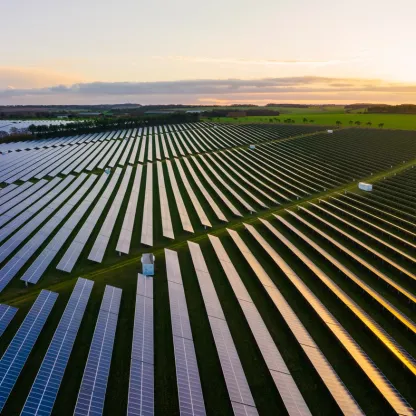
A potential solution to the question of long-term energy supply was articulated in a report published by the International Renewable Energy Agency (IRENA) which argued that conventional wisdom about the weather-related intermittency of solar and wind energy provision was now obsolete. IRENA’s report hailed the arrival of “24/7 renewables”, driven by technological and manufacturing improvements made by Chinese battery producers. A dramatic decrease in the cost of utility-scale battery installation meant that projects combining solar and wind generation with battery storage could now deliver competitively priced 24-hour power provision. While questions remain about scalability and the manufacturing and supply chain dominance of China, IRENA insisted that accelerated deployment would make utility-scale battery storage a first-option “baseload” energy model rather than a fossil fuel backup.