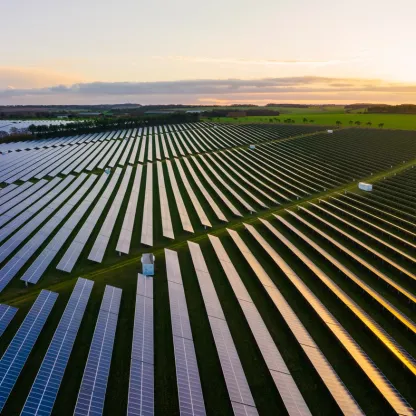
Greenbank recently organised a visit to the Grange wind farm in the Fens of East Anglia, investment analyst Will Findlay-Wilson reflects on observations from the site and sets out some of the key considerations in onshore wind generation.
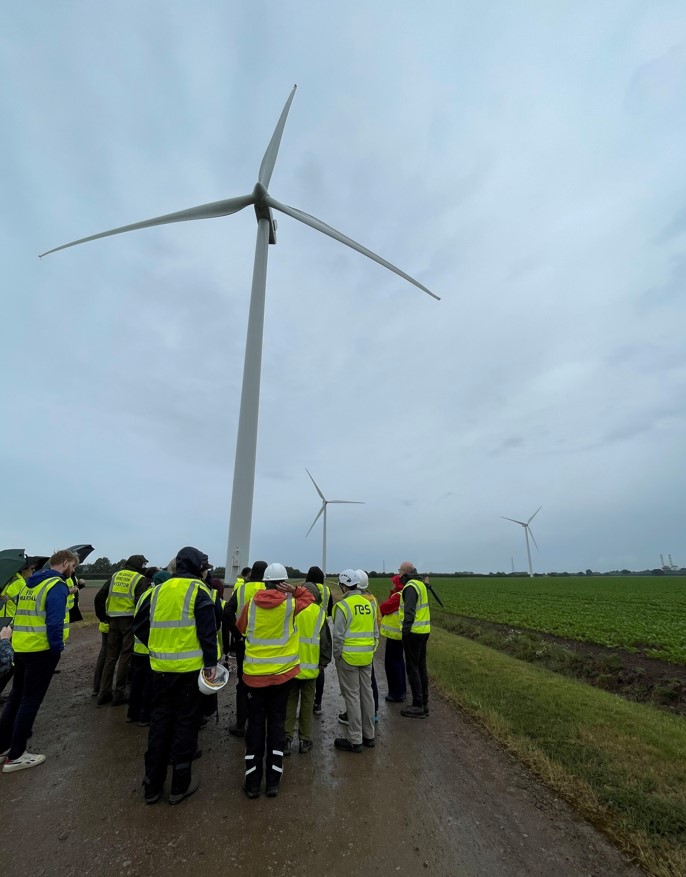
Greenbank visit to The Grange Wind Farm
23 June 2026
Article last updated 23 June 2026.

Will Findlay-Wilson, Investment Analyst
Introduction
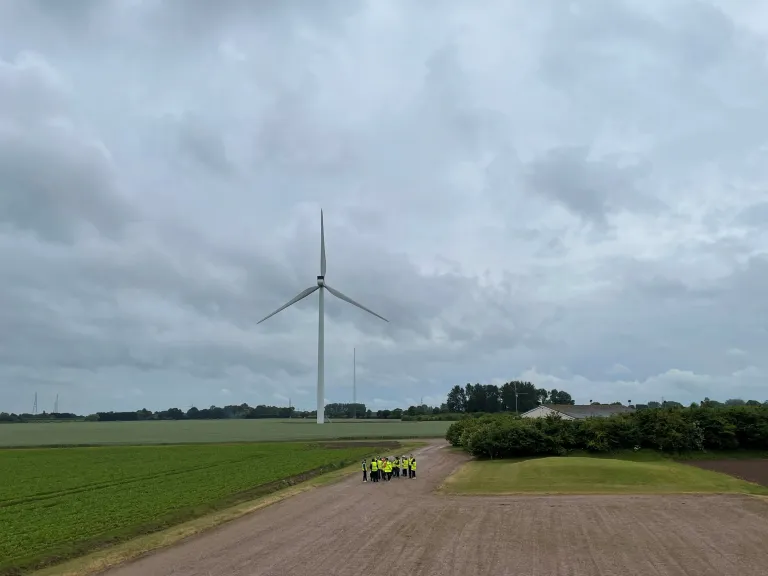
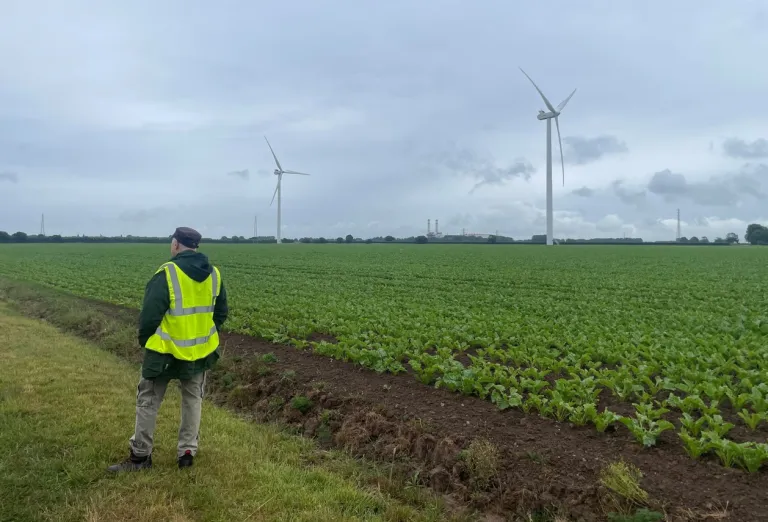
The fens are perhaps best known as Britain’s most arable farmland, where fields of wheat, potatoes, salads and sugar beet stretch as far as the eye can see. However, on this uncharacteristically wet and blustery June morning, it was not the crops that drew our attention, but the impressive structures towering 80 metres above us.
Each turn of the rotors above captured energy from a source that is both free and renewable. However, generation is only part of the story. As we scale this opportunity, the next challenge is delivering that energy across the country, on demand. Our visit to the Grange wind farm was an opportunity to understand where sites like the Grange fit into the UK energy system, where that system stands today, and where we might be heading.
The investment
The Grange is owned by The Renewable Infrastructure Group (TRIG), a renewable infrastructure investment held across many Greenbank portfolios. TRIG is an investment fund that owns assets across Europe: from solar in Spain, to offshore wind in Germany and onshore wind in the UK, including the Grange. TRIG’s wider portfolio of assets has a combined generating capacity of 2.3GW (gigawatts) and generated 5.4 TWh (terawatt-hours) of electricity in 2025, equivalent to powering around 1.6 million average UK homes over the year.
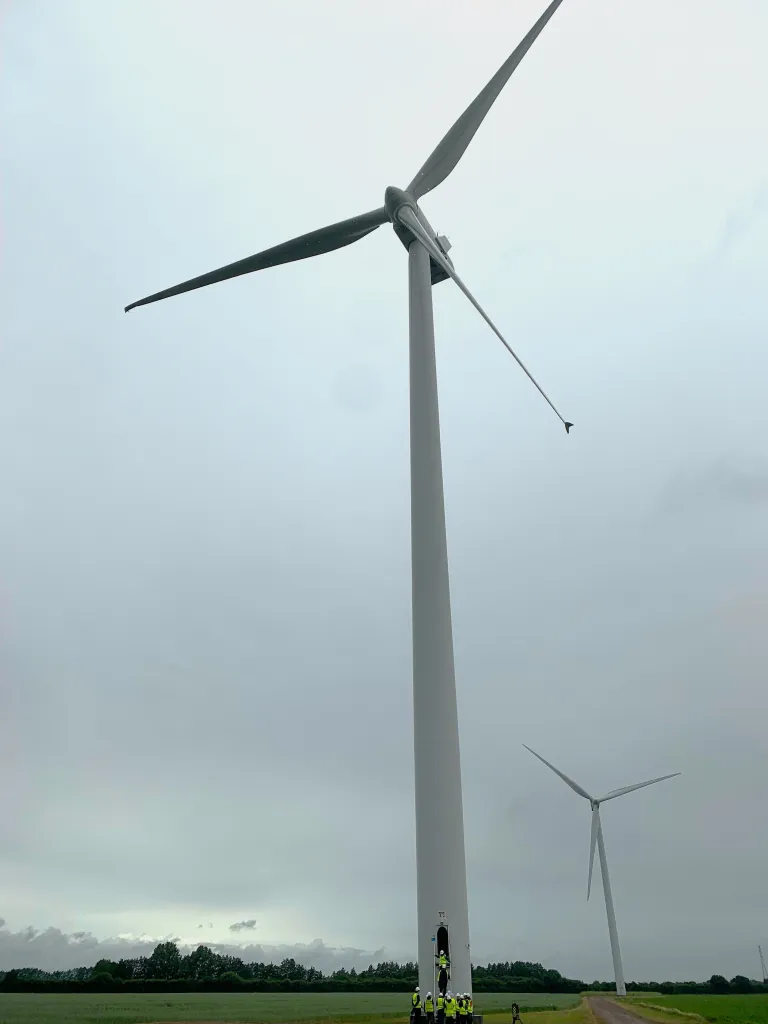
How The Grange works
Atop each of the Grange’s >80m towers, or hubs as they are called, sit turbines designed by Danish company Vestas. These 90m diameter rotors are 2MW by specification, giving the site a total installed capacity of 14MW across its seven units. For those less familiar with these measures, capacity represents the theoretical maximum output of a power source operating at full capacity and availability (as explored in our visit to Parsonage Solar Farm). However, for power-generating assets, maintenance may have to be undertaken, faults can lead to shutdowns, the wind doesn’t always blow, and the sun doesn’t always shine – no site always operates at full capacity. The Grange produces 45,000 MWh (megawatt-hours) of electricity annually. This is the equivalent of powering approximately 14,000 households.
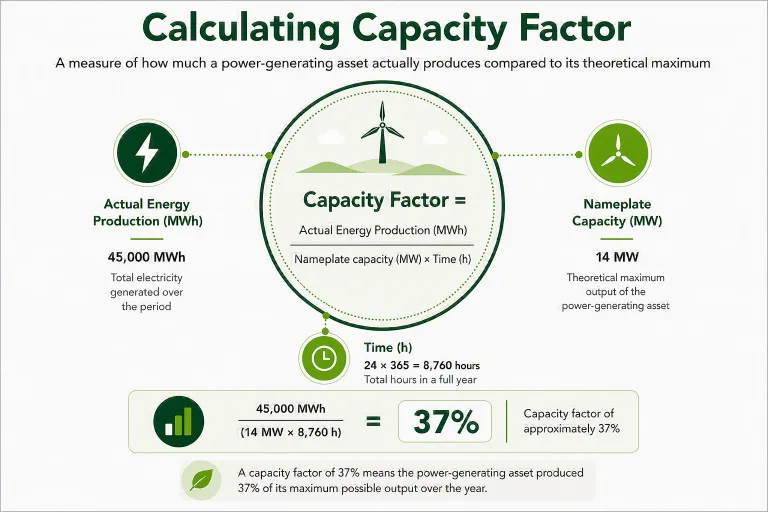
Interestingly, the flatness of the surrounding countryside creates consistent wind resource, with low wind shear (the wind speed remains relatively constant across the entire height of the spinning rotor) and low turbulence when compared to more undulating landscapes. As a result, stresses on the formidable construction above are lower, leaving less room for broken equipment, downtime, and more reliable operation. All this is beneficial for investors and users seeking dependable power generation.
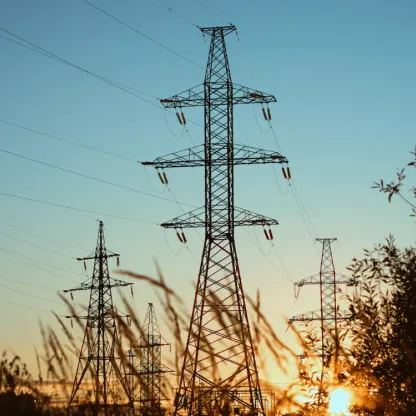
Generation is, however, only part of the equation. Individual turbines rotate at 20-30rpm, generating electricity that is collected at the site transformer and converted to 33kV, ready for distribution across the region. As the UK brings more renewables online, and begins transporting electricity across the UK, the grid is becoming a key constraint, and securing grid connection is increasingly critical. The Grange falls within the remit of the local distribution network operated by UK Power Networks (UKPN), which manages connectivity infrastructure across the East of England and beyond. This network, a web of overhead lines, towers, and a grid that stretches across the region (see Network Infrastructure Map)
To the Wider World
As we move beyond the Grange, assets scale dramatically. Hornsea 1, located 120km off the Yorkshire coast, is another investment within the TRIG portfolio. Hornsea 1 comprises 174 turbines, each with a power output of 7MW, which, at 1.218 gigawatts, is more than 800 times the capacity of the Grange.
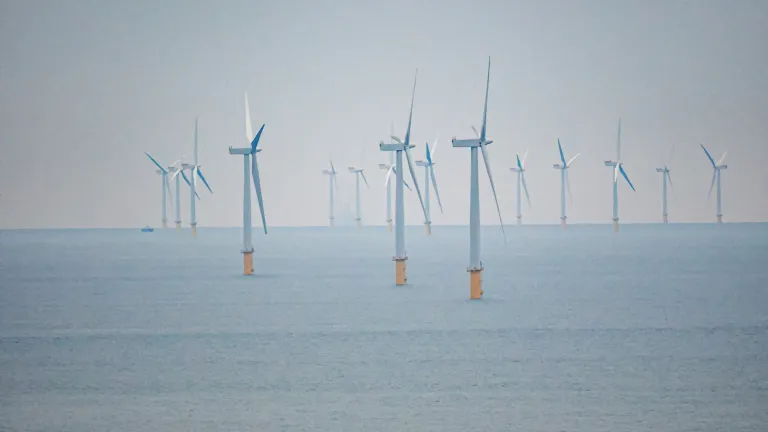
Beyond capacity, with no terrain to disrupt wind flow, there is a smoother wind profile and higher wind speeds offshore, meaning more hours near optimal turbine output. This contributes to a capacity factor higher than onshore wind, typically 40-50%. According to the Crown Estates, 52TWh of electricity was produced by offshore wind across 2025, enough to power over 16.5m UK households. The scale of this generation, driven and delivered by the UK’s natural weather resource, is understandably exciting.
Looking ahead, with more space comes larger turbines, and higher hubs with larger blades generate more energy. Offshore wind turbines have steadily been increasing in size over the past 15 years. The newest prototypes in Europe reach 21MW, and China’s Dongfang Electric has produced a turbine of 26MW. These turbines are vast: rotor diameters exceed 250m, and foundation weights are expected to surpass 3000 tonnes by some estimates. These structures require deeper cement foundations, more steel, and larger ships for installation 100s of Kms offshore. The soft fields of East Anglia, with relatively low stresses and strains and gentle wind speeds, are a walk in the park by comparison.
More importantly, the UK’s energy system is shifting from centralised generation around population centres in London and the Midlands to distributed generation and interconnection around the edges of the country. In so doing, high voltage grid connections in more remote regions need to be developed alongside upgrades to the onshore electricity network to absorb the increased load. Without these improvements, the system will continue to face curtailment, the intentional reduction of renewable output when generation exceeds grid capacity, transmission capability or demand.
While assets like the Grange are rarely curtailed, the grid connecting Northern Scottish wind assets to demand centres does not always have capacity to transport the power generated, and is curtailed frequently. We have the power, but we need to get it to the places it is needed! Upgrading the grid would enable better use of the energy already generated, should reduce use of gas peaker plants, and help bring energy costs down.
That is why National Grid (another Greenbank investment) is embarking upon the Great Grid Upgrade, delivering projects like EGL2 connecting Peterhead in Scotland to Drax in North Yorkshire via a 500km subsea cable with 2GW of capacity. Just one of many projects being undertaken across the UK to build the grid of the future.
In Conclusion
The Grange sits within a patchwork of renewable energy assets that provide real power today. Not the biggest by any means, but with an annual output equivalent to more than one-third of the population of the nearest large settlement of Wisbech, the Grange is emblematic of the important role played by distributed renewable power. Infrastructure projects in the UK are underway to deliver this vision across the country, and the wind industry in Europe and beyond is building more powerful generators for the future. The next time you look out and see a turbine turning in the wind, it’s worth remembering that the industry itself is also in motion.
Post Script
For those interested in the daily makeup of UK energy, National Grid Live is a great free resource. The following video is also a useful explanation of the current constraints and possible solutions for the flow of (renewable) energy across the UK: Why Is Britain Turning Off Its Own Wind Farms?
This information should not be taken as financial advice or a recommendation.