To celebrate the 21st anniversary of Greenbank, founder and investment director Elizabeth Haigh is catching up with inspiring women she has worked with over the course of her career in ethical and sustainable investment. In the third in this series, Elizabeth spoke with Nicola Day, deputy head of Greenbank.
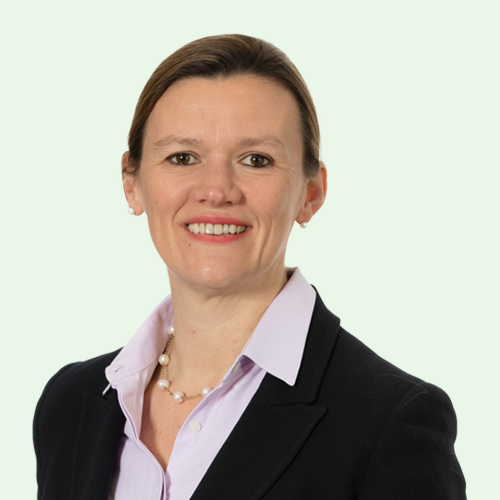
Speaking sustainably: A conversation with Nicola Day
18 December 2025
Article last updated 18 December 2025.

Elizabeth Haigh
Investment Director and founder of Greenbank
Nicola and I caught up over a coffee in the foyer of our new Bristol office in the EQ Building. I asked Nicola how she had started her career in finance. Her interest in maths and science, and their practical application in the workplace, had led her to switch her studies from medicine to economics. In addition to her professional qualifications, Nicola would go on, in her own time, to complete one of the first master’s degrees in Corporate Governance and Ethics and to receive a further master’s in Climate Change and Development.
In 1989, an internship and subsequent first job at investment house James Capel (then part of HSBC) came at the height of the enormous changes brought about by ‘Big Bang’ – the opening up of the traditional City firms to outside investors resulting in the explosion of demand for UK financial services.
Nicola thrived in the dynamic, often male dominated, culture of the 1990s. We recalled that, in those days, women frequently had to work twice as hard as men to get promoted!
James Capel was well-known for its Red Book which featured its recommended company investments. It subsequently published a Green Book, edited by Roger Hardman, the smaller companies specialist. This was a great source of green investment ideas before the advent of specialist sustainability research – my firm at the time also subscribed to it.
At a time when ethical considerations were largely absent from mainstream investment practice, Nicola identified this gap at James Capel and took the initiative to work with the Head of Compliance to design and introduce an ethical investment framework. This pioneering work significantly raised her profile, and in the early 1990s she was increasingly approached to manage specialist ethical mandates.
Her work on ethical criteria at James Capel proved to be a precursor to her most significant achievement at Barclays Wealth where she was the Head of the Ethical Investment Division prior to joining us at Greenbank in 2006. Drawing on her creative and analytical strengths, Nicola went on to design and lead a major programme that established a structured firm- wide approach to ethical investment across the whole of Barclays Wealth. This enhanced the credibility, coherence and depth to the firm’s ethical offering.
It was just two years after we had founded Greenbank in 2004 that Nicola joined us. We were delighted to welcome her and the whole team has benefited greatly from her ideas, expertise and commitment to her clients. Nicola initiated the framework for client reporting documents that laid the foundations for today’s meetings packs.
From the outset, Nicola felt strongly supported by working with like-minded colleagues who were also combining family responsibilities with demanding careers. When we first met, Nicola had just had her second son and she is very proud to have combined the hands-on responsibilities of family life with four children while forging a highly successful career at Greenbank. “You need to be efficient, work with a great team, and have an awful lot of energy, but it is easy to have that energy if you are passionate about your work!”.
It was very timely to be catching up with Nicola just as COP 30 was in full swing in Belém.
One of Nicola’s passions is understanding climate science and the effects of climate risk on investments. She has been in person to COPs 26, 27 and 28, and attended as a virtual delegate this year and in 2024. Our team has greatly benefitted from her insights and, despite the often slow pace of progress, she believes the COP process remains vitally important as a global platform to advance collective climate actions.
Nicola has always brought a scientific rigour to her own work in ethical finance and her involvement in the COP process has made her appreciate the huge challenges of negotiating climate action. There are still many unknowns, particularly in the areas of ocean currents and arctic weather patterns, but the evidence of climate change is irrefutable and starkly apparent in the bleaching of coral reefs and rising sea temperatures. We agreed that the impact of sustainable investing was more important than ever.
Finally, I asked her how investors can make the greatest impact over the next 21 years?
She believes the coming decades will be shaped by mounting societal and environmental challenges that will increasingly influence economic outcomes and investment returns. As a result, a sustainable approach to investing is becoming essential across all portfolios, as these factors are now financially material and integral to long-term growth.