From grid constraints and renewable energy growth to the challenge of tackling PFAS pollution, this month's sustainability update examines several of the environmental issues attracting attention from policymakers, businesses and investors.
Sustainability update July 2026
13 August 2026
Article last updated 13 August 2026.
Temporary shutdown of UK solar farm shows extent to which renewable energy generation is outpacing grid development
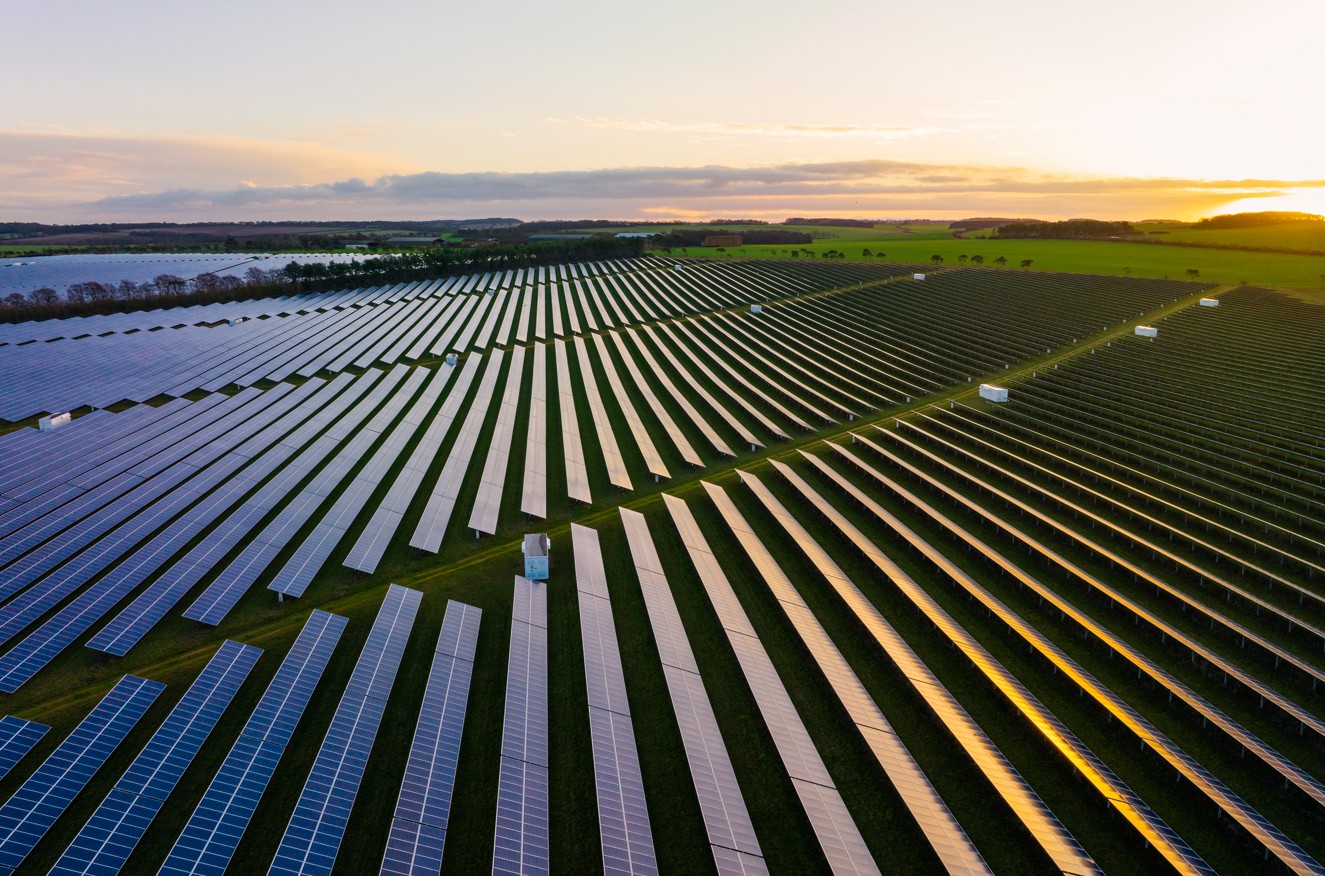
With UK solar generation increasing by almost 30% year on year, grid infrastructure is emerging as a major constraint on renewable energy growth. Much of the transmission network was not designed to handle large volumes of electricity flowing back into the system, and areas with high solar adoption often lack the spare capacity needed to connect new projects without substantial upgrades. These upgrades can be costly and uncertain, making project viability harder to assess. The challenge is compounded by multiple network operators using different processes and technical requirements.
As a result, the queue for grid connections has expanded far beyond what is required to deliver a decarbonised power system. Between 2020 and 2025, demand for grid access increased tenfold, creating a pipeline of more than 700 GW of projects, around four times greater than the UK's projected requirement for a fully clean power system by 2030. To address this, the National Energy System Operator (NESO) launched a major reform of the grid connection process in December 2025. Replacing the previous first-come, first-served approach, the new framework prioritises projects ready to proceed, helping reduce bottlenecks and unlock investment in clean energy infrastructure.
Alongside network reforms, NESO has expanded the use of consumer incentives to balance supply and demand. During the second quarter of 2026, the organisation paid consumers to reduce electricity use by 4,739 MWh, more than double the level achieved during the same period in 2025. Originally introduced during the 2022 energy crisis, NESO's Demand Flexibility Service has evolved into a year-round programme that supports peak demand reduction and renewable energy integration. Recent enhancements allow participants to be rewarded for both increasing and decreasing electricity consumption and extend eligibility to a wider range of assets.
The importance of strengthening the grid was highlighted by the temporary shutdown of Derril Water, the UK's largest community-owned solar project. NESO instructed National Grid to enforce the temporary shutdown for the duration of Derril Water’s first operational summer over concerns that excess generation could overload the local network. The project's board criticised the decision, noting that the shutdown order occurred without prior consultation and specialist equipment upgrades scheduled for rollout in 2025 to manage instances of capacity overload had not yet been installed. With almost 10,000 local stakeholders involved, the shutdown is expected to result in up to £2 million of lost revenue, underscoring the economic consequences of infrastructure constraints on renewable energy development.
Comprehensive new study concludes “forever chemicals” pollution must be stopped at source
Per- and polyfluoroalkyl substances (PFAS) are a large group of synthetic chemicals used in a wide range of industrial processes and consumer products for their long-term resistance to heat, water and oil. Their strong carbon-fluorine bonds make them highly durable but also extremely persistent in the environment and the human body, leading to their description as “forever chemicals”.
Their widespread presence and durability generate long-term environmental risks to ecosystems and wildlife. The risk of PFAS transfer to humans through the food chain is considerable as they accumulate in animals much faster than they can be metabolised. Alongside contaminated food, water and air, human exposure to PFAS can be exacerbated by chemically treated products such as non-stick cookware, clothing and carpets, and cosmetics. People working in professions like chemical manufacturing, electronics production and firefighting also risk increased occupational exposure. Past scientific studies have linked PFAS exposure to a variety of adverse health outcomes, including increased cancer risk, reduced immune response, hormonal disruption, and complications in reproduction and developmental progress. PFAS toxicity levels differ from one chemical formula to the next, and not all variants have been sufficiently tested.
A study published by the Royal Society of Chemistry assessed the potential costs and impacts of limiting PFAS exposure and pollution across Europe against two remediation scenarios: a “legacy” option targeting the cleanup of existing environmental PFAS, and a preventative option targeting scaled reductions in future PFAS emissions. In the legacy scenario, the study estimated that removing environmental PFAS in the current cycle of production and use would cost anywhere between €52 billion and €200 billion a year. However, it predicted that even the most aggressive remediation methods would remove less than 2% of existing environmental PFAS. The legacy scenario was further complicated by high concentrations of environmental trifluoroacetic acid (TFA), a compound widely used in organic synthesis that accumulates everywhere and is extremely difficult to remove. Increasingly found in human biology, TFA is also known to be toxic for aquatic life, even at low concentrations.
With “unprecedented” spending on the legacy scenario unlikely to significantly reduce existing environmental PFAS, the study maintained that increasing investment in prevention, innovation and reduced emissions would be more effective. It further argued that an annual investment of €50 billion through the “polluter pays” and Extended Producer Responsibility principles would help to offset minimum health and remediation costs, but that full remediation of environmental PFAS was “financially unachievable”.
Despite these concerns, PFAS play an important role in several low-carbon and clean technology applications. They are used in hydrogen fuel cells, advanced batteries, wind turbines, solar panels and semiconductor manufacturing. As a result, policymakers and companies are increasingly seeking to retain PFAS in essential-use applications while replacing them in non-essential consumer products and accelerating the development of safer alternatives. Rathbones supports this transition through its participation in the Investor Initiative on Hazardous Chemicals (IIHC), a coalition representing over $23 trillion in assets that engages chemical companies on transparency, phase-out plans, production reduction and investment in safer substitutes.
London Climate Action Week 2026 (LCAW) urges “climate cooperation in a fragmented world”
The backdrop to this year’s LCAW couldn’t have been more fitting or discomforting. With tens of thousands of participants crossing the capital to reflect on the progress of climate change and adaptation, schools in London closed early and employees were advised to work remotely as record-breaking heat took hold – an LCAW event to discuss global adaptation to extreme heat at the London School of Economics' Shaw Library was cancelled after organisers agreed that the venue was too hot to risk the wellbeing of attendees.
Across the 1,300 events that did take place, participants discussed everything from AI datacentres and the constraints of grid connectivity to food systems, oceans, and climate finance. Energy security, affordability and economic resilience were among the dominant discussion of themes. With current geopolitical fractures exposing the volatility of fossil fuel energy markets and the vulnerability of global trade routes, the necessary shift to clean, renewable energy was emphasised by the observation that none of it has to travel through the Strait of Hormuz. Another defining theme across keynote speeches was the transition from climate ambition to implementation and how companies can deliver credible net-zero action and tangible results in an increasingly complex operating environment.
Members of Rathbones’ Responsible Investment Centre of Excellence attended a mix of sessions at LCAW 2026. Their report on the event can be read here.