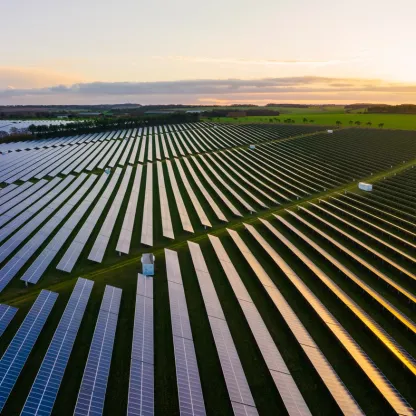
Q1 2026 saw global markets unsettled by geopolitical conflict, surging energy prices and renewed inflation risks, fragmenting performance across regions and sectors while sharpening focus on energy security and the transition to renewables.

Q1 2026 Market commentary
16 April 2026
Article last updated 16 April 2026.
After experiencing a steady start, the first quarter of 2026 saw global financial markets become more fragmented, volatile, and inflation sensitive as they negotiated a complex mix of geopolitical and geoeconomic headwinds . Across the globe, major economies were confronted with spiralling energy prices, renewed inflationary pressures, shifting monetary policy expectations, and emerging geopolitical challenges.
The most immediate and influential disruption to global markets came from the sharp rise in energy prices driven by US-Israeli strikes in Iran and Iranian countermeasures across the Middle East. Price volatility and supply limitations fed directly into inflation and corporate cost dynamics, while a surge in global energy stocks accentuated the losses made in most other sectors – commodities delivered substantial returns during Q1, driven predominantly by the energy component and reports of missile strikes at power facilities across the Gulf. Rising energy costs also prompted a reassessment of the disinflation narrative in most major economies where inflation remained above central bank targets, renewing uncertainty around likely policy decisions. Market uncertainty about the long-term consequences of conflict in the Middle East was exacerbated by conflicting progress reports and the lack of a clear commitment from the US on an exit strategy.
From an energy transition perspective, the recent Middle East conflict serves as another shock to the system for companies and markets that are dependent on fossil fuel inputs or beholden to hydrocarbon commodity prices. The Ukraine situation already brought energy security into focus, and the latest tensions bring it back to the fore. Politics aside, in many regions this can only help to reinforce how renewable energy, storage and electric vehicles can combine to provide alternative energy sources, as well as tackling climate change. Our research indicates how this could accelerate demand for the related critical minerals and components to keep up with clean technology deployment. Indeed, engagement around resolving grid constraints and smarter demand management is a priority in alleviating renewables curtailment issues in some markets.
Global trade dynamics were again under the spotlight after the US Supreme Court ruled 6-3 that the International Emergency Economic Powers Act (IEEPA) invoked by President Trump to justify his “Liberation Day” reciprocal tariffs did not grant him the authority to impose them. Trump’s immediate response was to criticise the ruling and announce a 10% global tariff, raising doubts about the validity of recent international trade deals. The ruling also complicated calculations in the federal budget where tariffs were supposed to balance a trillion-dollar deficit left by tax cuts introduced in the One Big Beautiful Bill Act.
Exposure to these headwinds was reflected across struggling equity markets. The S&P 500 fell 4.3% over the quarter – the weakest quarter for US large cap equities since 2022 – while European markets registered a 2.3% fall due to geopolitical uncertainties and the effect of rising energy prices on regional growth forecasts. Japanese stocks were the outliers among major equity markets, boosted by an export-friendly Yen and the landslide victory of Japan’s ruling Liberal Democratic Party in February’s snap election which renewed optimism for increased growth stimulus.
Growth forecasts in the US at the beginning of the quarter remained favourable, supported by a strong labour market, increased consumer spending and reduced inflationary pressures – with investors anticipating continued growth across sectors, the Dow closed above 50,000 for the first time in early February. Thereafter, events in the Middle East and sticky domestic inflation served to shift investor sentiment. Equities retreated through March as conflict spread to the Gulf states while Federal Reserve chair Jerome Powell announced the Fed’s decision to hold interest rates at 3.5%-3.75%. Powell’s tenure as chair ends in May and the man tipped to replace him – former Federal Reserve Board member Kevin Warsh – is widely considered to be a more market-friendly alternative. Unsurprisingly, energy production and infrastructure companies were the chief beneficiaries of increasing oil prices, however basic materials, chemicals and other commodity processers also benefitted from the effects of wider supply disruption. As a net energy exporter, US bond markets proved to be more resilient to rising energy costs than their European and Asian counterparts.
Despite strong revenue reports from US tech companies, tech stocks experienced a marked decline over the quarter, especially in the software sector. Concerns that generative AI could undermine the tech industry’s software-as-a-service (SaaS) model saw investors rotate away from software developers towards supporting infrastructure such as semiconductors and data-centre providers.
Performance in the UK energy and tech sectors mirrored the gains and losses experienced in the US. The basic materials, telecoms and healthcare sectors recorded healthy gains with large pharmaceutical companies benefiting from strong corporate earnings, large-scale deals to expand drug pipelines, and a three-year agreement to cut all tariffs for UK pharma exports to the US . Inflation held at 3% across the quarter, though economists warned that a “brutal” inflation surge could be in the offing due to the country's reliance on oil and gas imports . The conflict in the Middle East increased pressure on the central bank which was already dealing with a stubbornly high domestic inflation rate – while the Bank of England held the base rate of interest at 3.75% in March, its statement struck a hawkish tone suggesting future hikes could be used to drive inflation towards its 2% baseline target.
The Eurozone began the year with slow but positive growth expectations, however analysis across the manufacturing and services sectors over Q1 suggested the regional economy was nearing stagnation. Growth rates across member states varied significantly: while Spain remained resilient, growth fell sharply in Germany, and France and Italy showed signs of contraction. After the European Central Bank’s declaration in February that inflation was “in a good place”, the energy shocks that followed saw Eurozone inflation rise from 1.9% to 2.5% . The spike prompted a reassessment of the ECB’s hitherto stable policy stance with markets bracing for renewed inflation risk through 2026 – before the March energy shocks, the ECB had already projected a rise in headline inflation to 3.1% during Q2, fuelling speculation around future interest rate hikes.
Geoeconomic confrontation tops World Economic Forum’s Global Risks Report for the first time
Drawing on data from more than 1,300 experts, the WEF’s Global Risks Report 2026 assessed how material risks were evolving across short-, medium- and long-term time horizons. Deep uncertainty was the defining theme – 50% of respondents predicted “turbulent” or “stormy” conditions over the next two years, while 57% anticipated protracted global instability. Declining trust, reduced transparency and heightened protectionism were among the main factors undermining the multilateral system.
For the first time in the report’s history, geoeconomic confrontation was ranked as the world’s most significant risk. This included the use of tariffs, trade restrictions and investment controls as instruments of geopolitical competition and coercion, reflecting a clear shift among trading powers towards economic rivalry over cooperation. The report framed 2026 as the start of an “age of competition” marked by an increasingly contested multipolar landscape. Misinformation and disinformation ranked among the most severe near-term risks, driven by concerns about political polarisation and information integrity. The potential adverse outcomes of AI technologies also rose significantly between two- and ten-year risk scenarios, while cyber insecurity remained a significant threat.
Economic downturn, inflation, and asset-bubble bursts were key drivers in increased economic risks, compounded by rising debt levels, volatile financial conditions and the effects of ongoing geopolitical tensions. Inequality, which acts as a factor in amplifying associated risks like economic instability and political fragmentation, was identified as the most interconnected global risk for the second consecutive year. While environmental risks like extreme weather events, biodiversity loss and ecosystem collapse, and critical Earth system change declined as near-term threats, they remained the top three global risks across ten-year timelines.
The High Seas Treaty: a historic achievement for multilateralism and a vital commitment to safeguard the planet’s “beating blue heart”
The international High Seas Treaty officially entered into force on 17 January. Almost two-thirds of global ocean coverage lies beyond national borders and unregulated activity on the high seas presents a growing threat to marine health. Destructive fishing methods like bottom trawling significantly impact marine ecosystems through the bycatch of non-target species and damage to the seafloor caused by net dragging. Ecosystem damage is compounded by plastic and chemical pollution, emerging activities like seabed mining, and increasing ocean acidification generated by rising temperatures. The High Seas Treaty heralds a new era of global ocean governance, creating the first legal framework to establish a connected network of marine protected areas (MPAs) across the high seas and control harmful activities through environmental impact assessments. Most importantly, it aims to drive the transition from ocean exploitation to ocean stewardship and protection.
By March, 88 countries had ratified the Treaty . Despite parliamentary support and the introduction of preliminary legislation to align the UK with the Treaty’s obligations, the government stopped short of formal ratification and held back on a proposal to ban bottom trawling in all UK waters. In response, a coalition of environmental NGOs and campaign groups drafted an open letter to the government highlighting the country’s commitment to the Kunming-Montreal Global Biodiversity Framework and its pledge to designate 30% of the world’s land and sea as protected by 2030.
Climate Change Committee concludes that benefits of the UK’s net zero transition “consistently outweigh the costs”
Supplementary analysis by the UK Climate Change Committee (CCC) for its Seventh Carbon Budget report reinforced the case that the country’s 2050 net zero target was still achievable and that the associated costs were lower than the economic damage caused by periodic fossil fuel shocks. The updated report’s cost-benefit analysis incorporated a variety of co-impact assessments recommended by HM Treasury to support the investment case for policies and programmes, concluding that the UK’s Balanced Pathway strategy to decarbonise key sectors of the economy would deliver considerable value for money, with benefits outweighing costs by between 2 and 4 times.
Analysis also indicated that a fully electrified energy system would be more efficient and secure than the UK’s current system, with efficiency gains cutting energy waste by around £30 billion annually. Household energy price modelling against a 2022-level spike in fuel costs indicated that energy bill increases could reach 59 per cent in a fossil fuel scenario compared to 4 per cent under the Balanced Pathway – the total additional cost of a single 2022-level fossil fuel shock could be as large as the total net annual cost of delivering the Balanced Pathway by 2050.
The CCC’s central message was that decarbonisation was both affordable and economically advantageous. However, it stressed that all sectors had to contribute and that clear policy signals were needed to increase streams of private investment. It also highlighted the significant impact of households on emissions, emphasising that behavioural changes around EV uptake, energy-efficient home heating, and healthier diets all contributed to net zero goals.